PASSWORDS: HOW TO SECURE
YOUR ACCOUNTS WITH A ROBUST
PASSWORD ?
DID YOU KNOW THAT IT TAKES LESS THAN A MINUTE FOR ANY HACKER TO FIND A SIMPLE PASSWORD SUCH AS "COOKIE18" ?
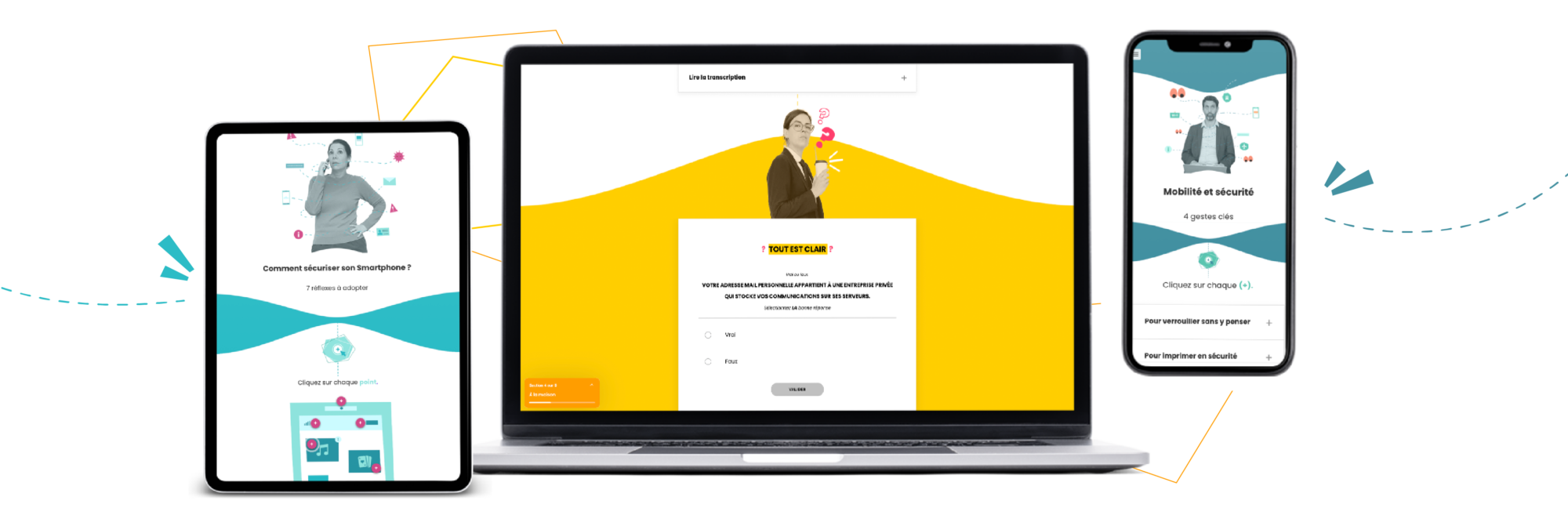
Simple passwords are a real security loophole that can allow malicious people to access all your data, as well as your company’s data! Data theft, loss of sensitive data ransom demand to get it back, and then the drama begins. To avoid such a scenario, eSkills has come up with Cybercafés, an e-learning training divided into 10-minute capsules to make employees aware of the various aspects of cybersecurity over a coffee!
By following the second capsule, you’ll get all the information you need to become a master in the art of creating a secure password to limit the risks of intrusion.
THE WEAKNESS OF STRAIGHTFORWARD PASSWORDS: AN OPEN DOOR TO HACKERS
Imagine that your password is the key that protects your company’s doors. Now visualise a worn-out key, easy to reproduce and guess. Straightforward passwords are like this worn-out key. They are an invitation to hackers to break into your online space.
Today’s hackers use increasingly sophisticated methods to decrypt even the weakest passwords and connect to your various user accounts, which is why it’s so important to come up with complex passwords that don’t follow any logic.
WHAT IS A STRAIGHTFORWARD PASSWORD?
A straightforward password has very few characters. It is often linked to something personal, such as the name of a family member, your date of birth, your pet, etc. On the podium of the easiest passwords to decrypt and the most widely used, in first place we have “123456”, closely followed by “motdepasse” or “password” and “querty”.
If you use one of these 3 passwords for your applications and online spaces, we invite you to follow our “password” capsule and change it immediately afterwards!
Cyber hackers use two methods to find out users’ passwords:
Social engineering : investigating the target person by searching on search engines and social networks
Brute force : using free software to try out all the variables in a word. For example, “cookie01”, “cookie02”, etc.
STORAGE OF PASSWORDS
Another entry point for hackers is password storage. You can have the most complex, strongest password there is, but depending on how you store it, it can be quickly found. Many people write down recurring passwords on a post-it note stuck to their computer screen, in a notebook containing all their passwords, or save them on their smartphone. These are risky practices, because if the notebook or smartphone is lost or stolen, the criminals can immediately access all your accesses, and therefore all your company data.
In our second instalment, we explain how to store your passwords securely and give you some tips on how to remember them more easily.
CYBERCAFÉS: TRAINING TO PROTECT YOU FROM PHISHING
The best defence against phishing is to acquire the knowledge that will enable everyone to adopt the right reflexes to ensure that everyone is safe when faced with this type of email. The first measure is to step back and take the time to analyse the suspect email.
With this in mind, we have created the Cybercafés, a series of 10-minute capsules on different themes designed to raise your employees’ awareness of good practice in cybersecurity and data protection. These capsules are punctuated by a humorous web series, featuring everyday situations, quizzes and fun media to help you integrate this new knowledge easily and sustainably.
In each capsule, users are put in a real-life situation in which it is easy for them to recognise themselves and understand how to use what they have learned to distinguish between genuine and falsified emails.